Start with what you actually need to carry
Before choosing a holder, lay out the documents your day trip calls for. That might be an ID, a transit pass, a booking confirmation or a paper ticket. Check what must be shown in its original form and what can be kept on your phone. Leave documents you do not need in a suitable secure place, rather than carrying every important item out of habit.
Think about when you will reach for each item. A train ticket you may show twice is different from a passport you expect to leave untouched until the end of the day. This distinction matters more than the name of the accessory: the best place for a document depends on whether you need quick access or discreet storage.
Choose a neck wallet for easier access
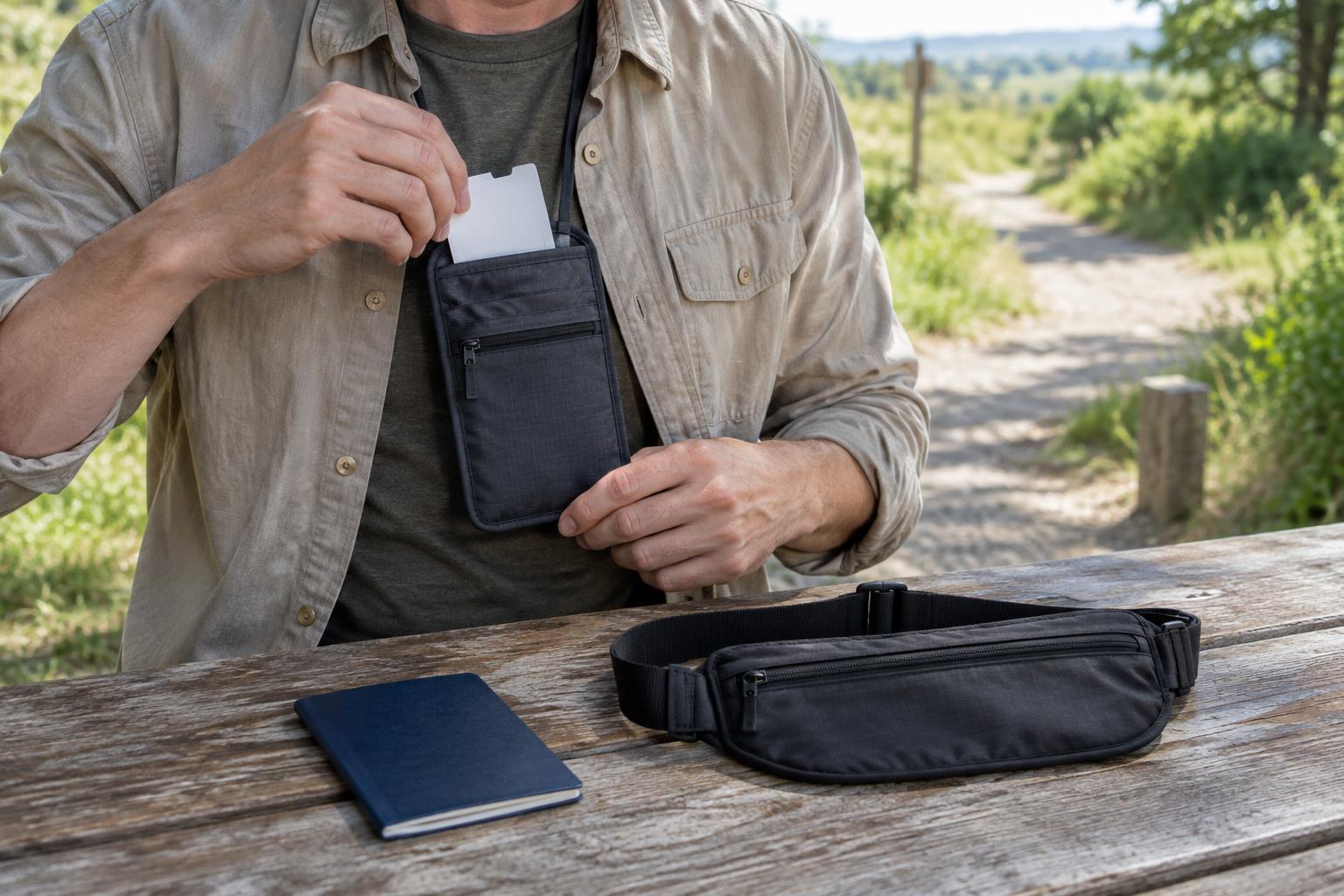
A neck wallet hangs from a cord and usually sits against your chest, either under or over a clothing layer. It can be convenient when you need to retrieve a document without taking off a backpack. Compartments may also help keep an ID separate from tickets and small amounts of cash. If you expect several ticket checks or changes of transport, that easy access can be useful.
The trade-off is comfort and visibility. A full wallet may swing as you walk, show through a thin shirt or feel warm against your skin. A cord can also rub at the neck, especially beneath a backpack strap or jacket collar. Try it on with the clothes you plan to wear, put only the essentials inside and walk around before relying on it for a full day. For a discreet setup, tuck it beneath your outer layer and allow enough cord length to retrieve it without pulling.
Choose a hidden pouch for items you rarely need
A hidden pouch may attach to a belt, sit inside a waistband or rest flat beneath clothing. Its main advantage is that it stays out of sight during ordinary movement. A slim pouch can work well for a document you want to keep close but do not expect to present often. Position and fit matter: a pouch that presses into your waist when you sit, or shifts as you walk, will become distracting.
The drawback is slower access. Retrieving an item from beneath layers in a queue can be awkward and may reveal where you keep it. If a ticket or pass will be checked repeatedly, keep that frequently used item in a separate, easy-to-reach pocket instead. Avoid packing a hidden pouch so tightly that documents bend or the closure strains. Neither style makes a document loss-proof; both still need a secure fastening and occasional checks.
Match the holder to your clothing and route
Picture the whole day, not just the first hour. A neck wallet may be straightforward with a loose shirt but uncomfortable under a fitted top. A waistband pouch may sit neatly beneath a jacket yet become hard to reach when you add a rain layer. If you will be walking for several hours, test your choice while carrying your usual daypack and sitting down as well as standing. Adjust the position until it does not interfere with straps, waistbands or movement.
Weather deserves a little planning too. A holder worn against the body can pick up perspiration, while rain may reach it when you open a jacket to get a ticket. If the contents need protection, use an appropriately sized protective sleeve or bag inside the holder, and make sure you can still remove the document easily. Keep paper items flat, and check that zips and seams close properly before you set out.
Use a simple system you can repeat
Give each essential item a consistent place. For example, keep the document you rarely need in the neck wallet or hidden pouch, and put the day’s transit pass in a secure pocket that you can reach without unpacking. Do not tuck loose papers into several different pockets; that makes it harder to tell whether something is missing. When you take a document out, pause to return it to the same compartment before moving on.
A quick check at natural stopping points—before leaving your accommodation, after a ticket inspection and before heading back—can catch a misplaced item early. The right accessory is the one you can wear comfortably, close reliably and use without a complicated routine. Choose a neck wallet if frequent access is the priority; choose a hidden pouch if discreet, low-access storage matters more. If neither feels comfortable with your day-trip clothing, a secure interior pocket may be the simpler option.