Know which lock you have
Trekking poles commonly use external lever locks, internal twist locks, or a combination of the two. A lever lock clamps around a sliding pole section when its lever closes. A twist lock usually expands an internal piece as one section turns against another. Both need clean contact surfaces to hold their adjustment. Dirt, sand, dried mud, and trapped moisture can make a lock hard to operate or allow a section to slip.
Before cleaning, extend and collapse each pole slowly. Note where the joints sit, how the locks feel, and whether a section slips when you press down gently on the handle. If the poles have printed stop or maximum-extension marks, keep the sections within those limits. Check the maker’s care instructions before taking any lock apart: some parts are designed to be removed by hand, while others are easy to damage or misassemble.
Clean grit from lever locks
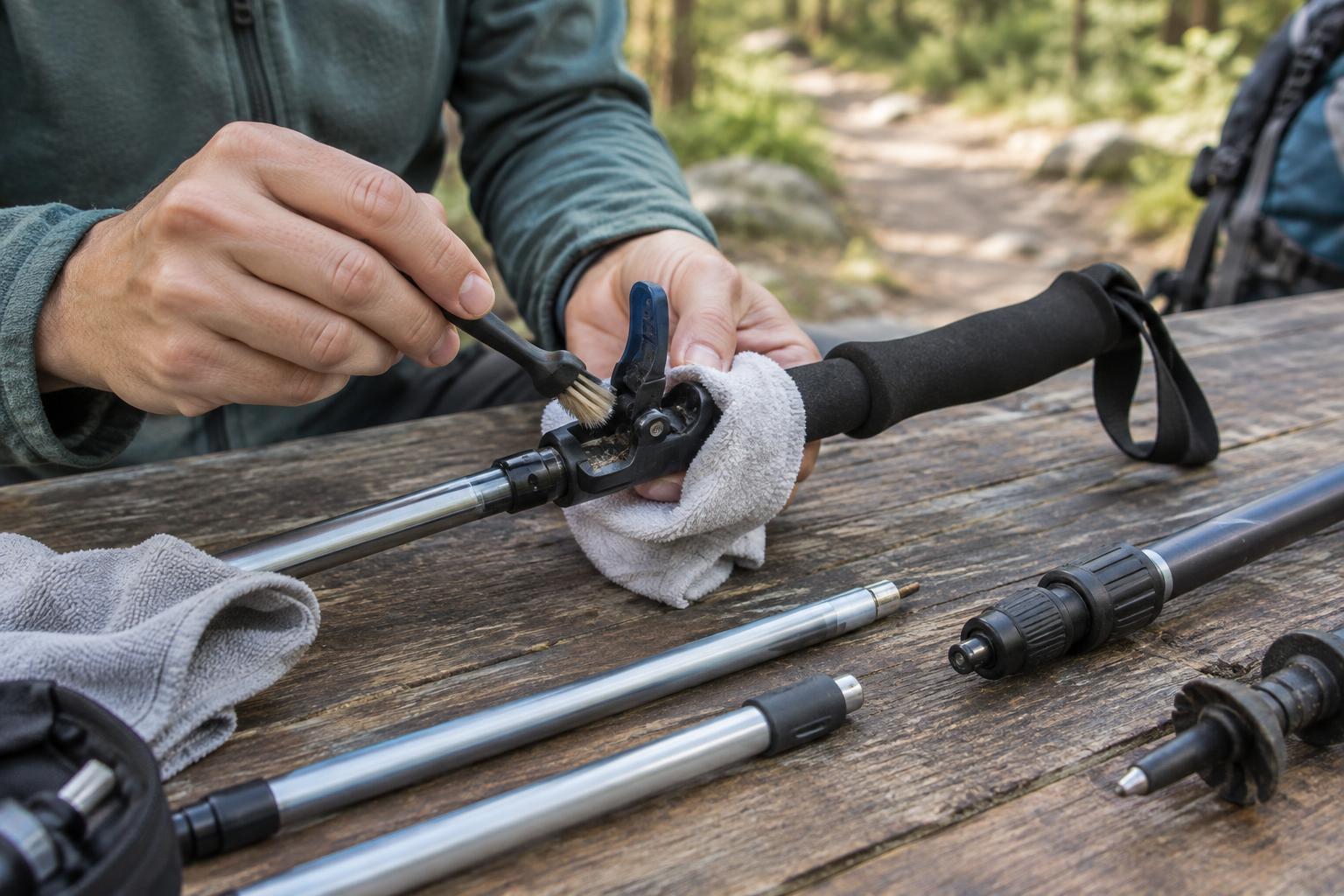
Open the lever and slide the lower section out only if the pole’s design permits it. Wipe the exposed tube with a soft, damp cloth, paying attention to the area normally held by the clamp. Use a soft brush, such as an old toothbrush, to lift grit from the hinge and the edges of the clamp. For stubborn mud, use a little mild soap on the cloth or brush, then wipe away the residue with a clean, damp cloth. Avoid forcing dirt deeper into the joint.
Dry the tube and clamp thoroughly before reassembly. Close the lever and test the grip with the pole set to a normal walking length. Many lever locks have an adjustment screw or nut: if the lever closes with almost no resistance and the section slips, a small adjustment may help. If it takes excessive force to close, ease the adjustment instead. Make changes gradually, checking the grip after each one, and do not overtighten a plastic clamp to compensate for a worn or damaged part.
Care for twist locks without making them slippery
Twist locks can collect grit inside the pole, where it is less visible. If the sections are removable according to the maker’s instructions, separate them over a clear work surface so small pieces cannot roll away. Wipe the inner tube and the accessible inside of the outer tube with a soft cloth. A narrow, soft brush can help with loose dust. Clean the expanding piece gently and note its orientation before removing it, if removal is necessary.
Let every component dry fully before putting the pole back together. Avoid applying oil or grease to the surfaces that provide grip unless the manufacturer specifically calls for it; lubrication in the wrong place can encourage slipping or attract more dirt. Reassemble the sections, turn the lock until it holds firmly, and test it by applying steady downward pressure. If the lock spins without gripping, check that its parts are seated correctly rather than tightening harder and harder.
Dry and inspect the whole pole
After a wet or muddy trip, wipe down the full length of each pole, including the handle area, straps, baskets, and tips. Open the locks and allow accessible joints to air-dry before collapsing the poles for storage. If you have removed sections, lay them out where they will not be knocked over, and keep their parts together. A dry cloth is often enough after a dusty walk; a more careful cleaning is useful when grit is audible or adjustment feels rough.
As you work, look for cracks in clamps, bent levers, stripped adjustment hardware, dented tubes, and worn expansion pieces. Check that each section slides without catching and that both poles lock at a practical walking length. A lock that repeatedly slips after cleaning and careful adjustment may need a replacement part. Do not rely on a pole with a damaged lock for support on uneven ground.
Make maintenance a quick pre-walk habit
You do not need to dismantle your poles after every outing. A useful routine is to wipe off visible dirt when you finish, open damp locks so they can dry, and give the mechanisms a closer look whenever adjustment starts to feel different. Store the poles clean and dry rather than leaving them collapsed in a wet bag. If you travel with them, check the locks again after unpacking.
Before setting out, extend each pole within its marked range, close or tighten the locks, and press down steadily to confirm that the sections stay put. Repeat the check if you change the length during a walk. Cleaning helps preserve reliable grip, but the final test is whether each lock holds securely under ordinary use.