Look for continuous cover, not just a green line on a map
A route marked through woodland is a promising starting point, but it does not guarantee shade from beginning to end. The path may cross open fields, follow a wide track or pass beneath trees with little leaf cover. Start by looking at the whole route rather than its most attractive section. If a long exposed stretch falls near the end, you may reach it when you are tired and the day feels hottest.
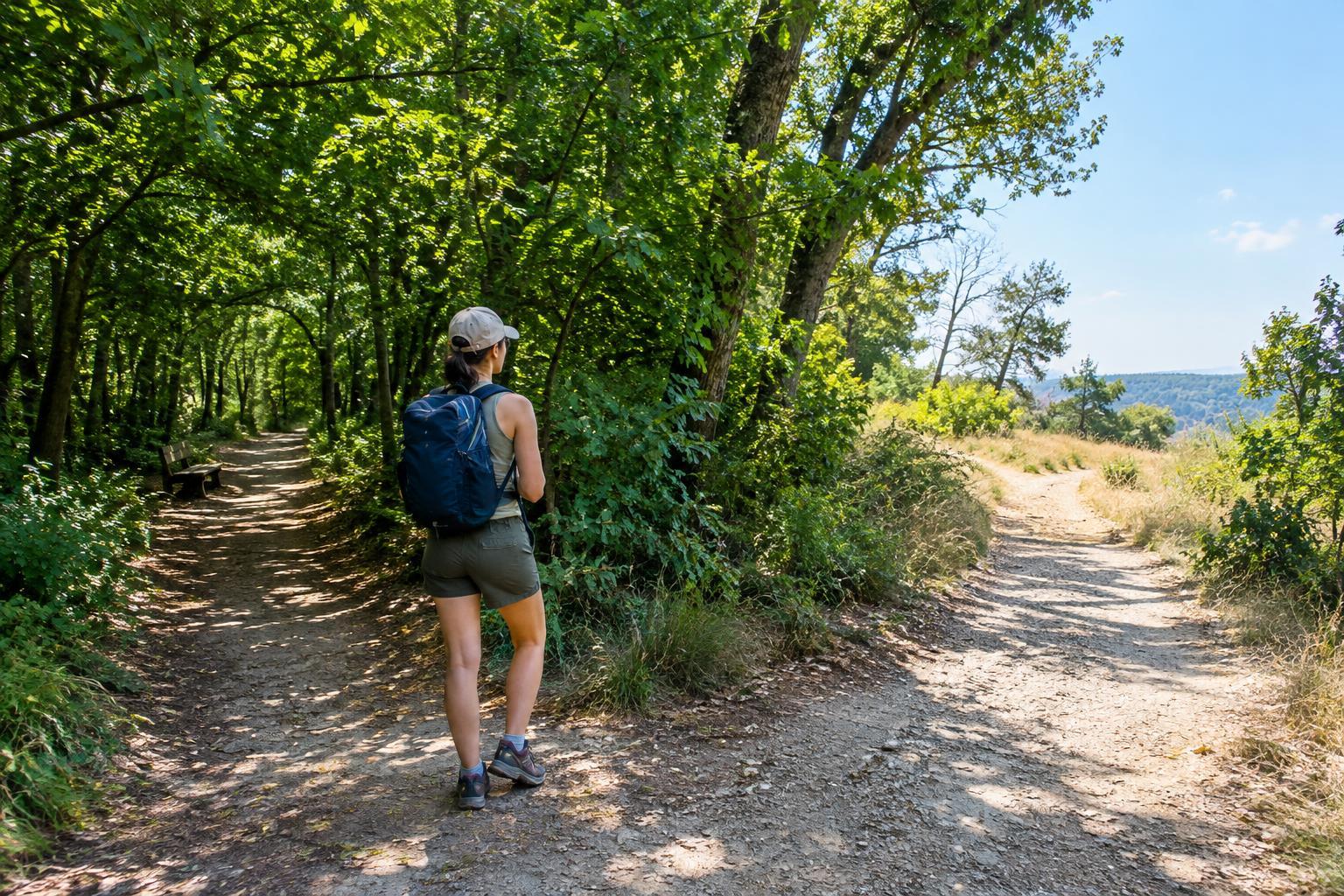
Maps and route descriptions can help you spot likely shelter: narrow paths through established woodland, wooded stream corridors and lanes with trees close to the walking surface. Aerial images may show breaks in the canopy, while recent visitor photos, when available, can help you judge whether trees actually overhang the path. Treat each clue as an estimate. Trees can be cut back, leaves change with the season, and a map cannot show exactly where the shade will fall.
Match the shade to the time you will walk
Shade moves throughout the day. A path beside a hedge or wall may be sheltered in the morning but fully exposed later. Likewise, trees beside a broad trail may shade one edge while leaving the walking surface in direct sun. If you know the route, think about which side of the path provides cover at your planned walking time. If you do not, favor routes with overhead tree cover or several shaded sections rather than relying on a single row of trees.
Timing can make a modestly shaded route more comfortable. Starting earlier or choosing a shorter walk may reduce the time spent on exposed ground during the warmest part of your outing. Check the expected conditions for the place you will walk, including whether cloud or breeze is likely to change. Neither is a substitute for a route you can comfortably complete if the sun stays out.
Compare the exposed sections before choosing
When deciding between two walks, measure the effort as well as the distance. A steep, open climb can feel more demanding than a longer, level woodland path. Look for open hilltops, field crossings, paved stretches and routes with little opportunity to shorten the walk. On an out-and-back trail, remember that any exposed section must be crossed twice unless there is another way home.
A useful choice has options. A loop with a shorter turn, a nearby shaded path or an easy return to the start gives you room to adjust if conditions feel harder than expected. Identify those points before leaving, especially when walking with children or companions who prefer a slower pace. Do not assume that a streamside route offers drinking water, or that a wooded path will have benches or facilities.
Check the ground beneath the trees
Shade is only one part of a comfortable walk. Woodland paths can have roots, loose stones or muddy patches that slow your pace. A deep valley may feel sheltered but involve a climb back out. Read the route notes for surface and elevation, and choose footwear suited to the ground. A familiar, well-marked path may be a better hot-day choice than an unfamiliar trail that looks greener on a map.
Consider how you will reach and leave the route, too. A shaded trail does not help much if the approach involves a long walk across an open car park or along an exposed road. Check access points and any route restrictions ahead of time. Where information is limited, plan conservatively and be ready to change your walk once you see the conditions.
Set out with a simple fallback plan
Even a carefully chosen route may offer less shade than expected. Carry water, wear clothing that suits the conditions, and bring sun protection for uncovered sections. Tell someone your general plan if you are walking somewhere unfamiliar. As you go, notice whether the shaded pauses you expected are actually available; there is no need to press on to a planned endpoint if the route feels too exposed.
Before starting, decide what would make you turn around or take a shorter option, such as an unexpectedly open trail, slower progress or a companion who is struggling with the conditions. Choosing a shaded route is not about finding a perfectly sun-free walk. It is about knowing where the exposed parts are, limiting them where you can, and keeping an easy way back.