Choose for the walk home, not the brightest number
A headlamp is useful even when you intend to finish well before sunset. A longer-than-expected route, a leisurely stop or slower progress on uneven ground can turn the last stretch into a walk in low light. Unlike a handheld torch, a headlamp leaves your hands free for trekking poles, a map, a gate or a steadying grip. The best one for this purpose is the one you will bring along and can operate easily when you need it.
Start with the places you usually walk. A broad, comfortable beam can help you see nearby footing on paths and at campsites. A more focused beam helps you pick out a trail marker or turn farther ahead. If possible, choose a lamp that lets you switch between a lower, wider setting and a stronger setting. Maximum brightness can be handy briefly, but it is not the whole story: a dazzling beam is less useful if it drains the power supply quickly or makes it hard to see the ground close to your feet.
Think about usable runtime and power
Check how long a headlamp is expected to run on the setting you would actually use for walking. A runtime listed for the lowest mode may not tell you much if that mode is too dim for a rough path. Light output can also decrease as a battery runs down, so treat advertised runtime as a comparison point rather than a promise that the beam will stay equally bright throughout. Before a trip, test your lamp in a safe, familiar place to learn which setting gives you enough light.
Rechargeable lamps are convenient if you already carry a compatible charging cable and can top them up between outings. Replaceable batteries may suit trips where charging is awkward, provided you pack a fresh spare set and know how to change it. Some lamps offer both options. Whichever system you choose, keep it ready: charge it or check the batteries before leaving, and prevent accidental switch-ons in your bag by using a lock mode, protective case or the method recommended for your lamp.
Make comfort and controls part of the decision
A headlamp should stay in place without needing a tight strap. Try adjusting it over the hat or hood you might wear on a cold evening, then look down and turn your head. If it slips, bounces or presses uncomfortably against your forehead, you may be tempted to take it off just when you need it. A tilting lamp housing is helpful because you can aim light at the path without holding your head at an awkward angle.
Controls matter most when your hands are cold or you are tired. Look for a button you can find by touch and a sequence of modes you can remember. A low setting is useful for reading a map or finding something in a bag without flooding the area with light. A red-light mode can be convenient for close tasks when you want a less intrusive glow, but it is not a substitute for a walking beam. If the lamp has many modes, practise switching between the ones you will use.
Account for weather and packing
Day-trip gear gets exposed to drizzle, damp pockets and the occasional drop. Choose a headlamp with weather resistance appropriate to where you travel, and check what the maker’s rating actually covers; resistance to rain does not necessarily mean a lamp can be submerged. A simple design that you can wipe down and dry after use may be more useful for routine outings than features you rarely need.
Give the lamp a consistent home in your day bag, ideally in a small pocket or pouch you can reach without unpacking everything. Keep spare batteries or a charging cable with it if your plans call for them. Check that the strap is not tangled and the lamp turns on before you set out. These small habits do more for an unexpected late finish than buying a powerful light and leaving it at home.
Use the light to make a calm finish
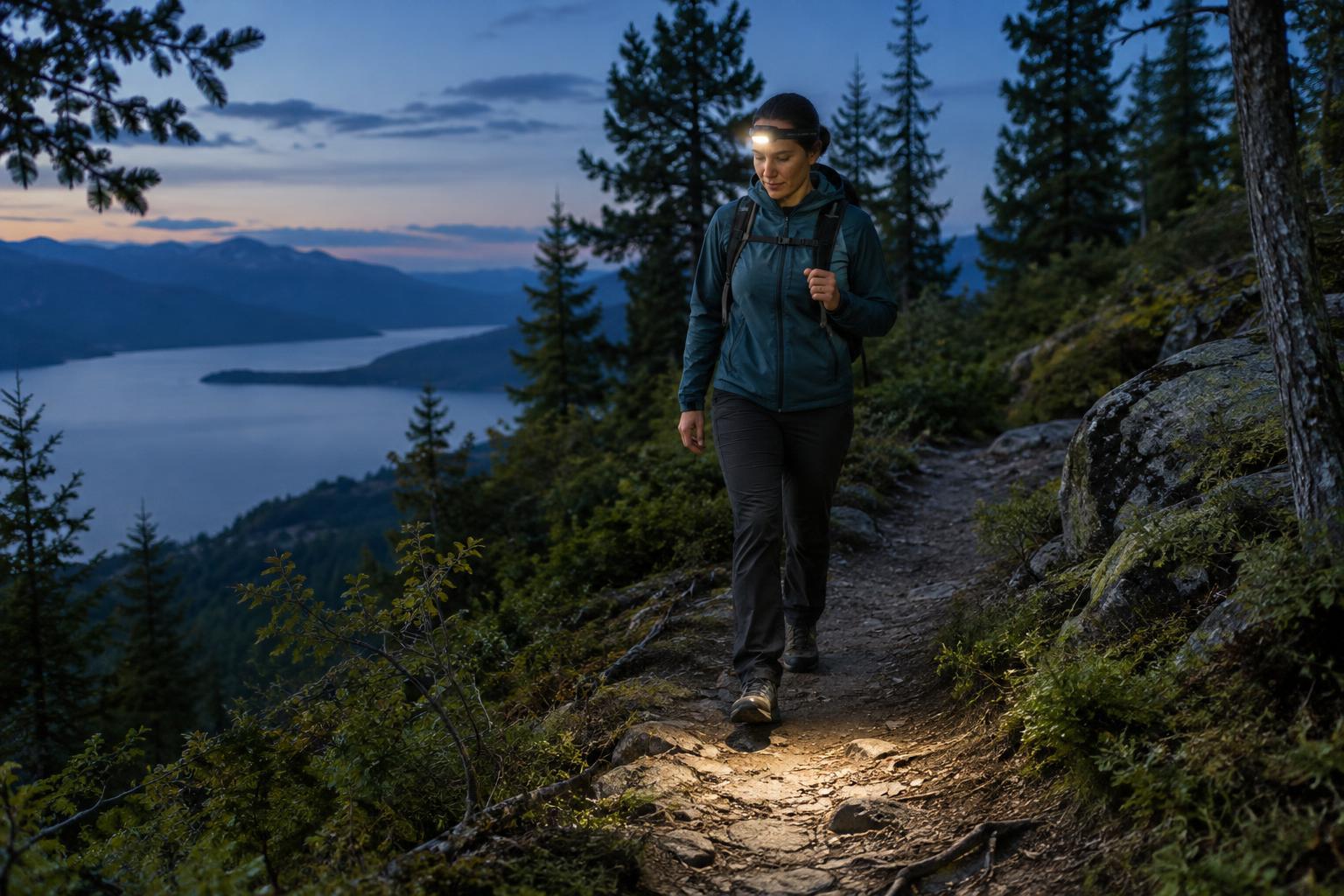
Switch the headlamp on before it becomes too dark to see the path clearly. Start on a modest setting, increase brightness when you need to read uneven ground or find a junction, and angle the beam downward around other walkers. Pause if you need to examine a map rather than trying to navigate while moving. If the route or conditions feel uncertain, a headlamp helps you see, but it does not make a difficult route safe on its own.
For most recreational day trips, a good choice is a compact, comfortable lamp with a useful walking beam, straightforward controls and a power system you can reliably maintain. Pack it routinely, learn its controls in advance and give yourself time to use it without rushing. That way, a late finish remains a manageable change of plan rather than a scramble for light.