Decide when poles are useful
Trekking poles are optional for many day walks. They can give you additional points of contact on loose stones, uneven paths and moderate slopes. Some walkers also find that poles help them keep a steady rhythm. They do not make slippery ground safe, however, and they are no substitute for slowing down or choosing a different route.
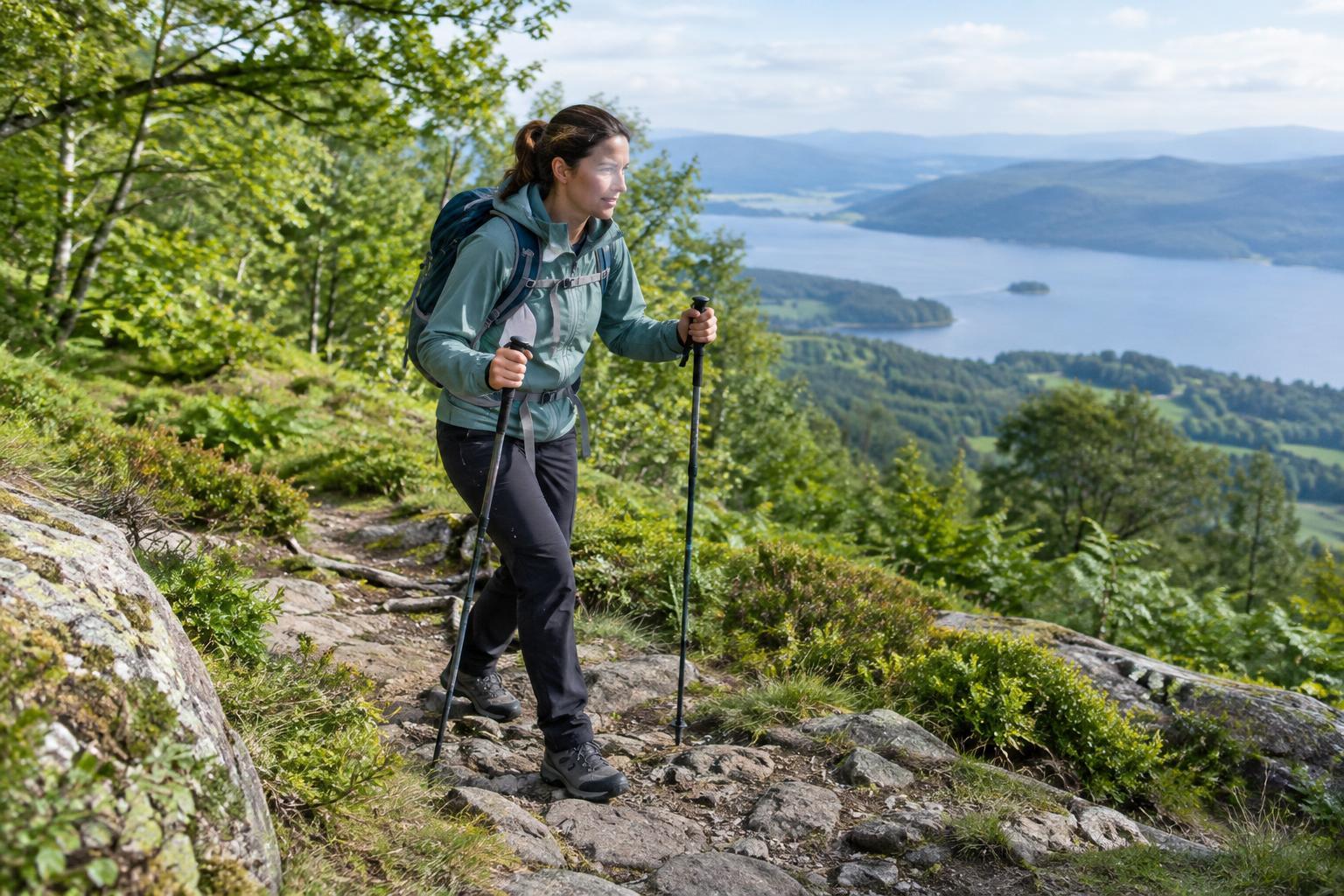
Think about where you will use them before setting off. On a broad, firm path, you might prefer to carry them so your hands are free. On a narrow or rocky section, having a pole in each hand may help you test your footing and balance. If you are new to poles, practice on easy ground first. That gives you time to learn where the tips land without also having to negotiate a difficult trail.
Adjust the length and hold them comfortably
For level ground, start with a pole length that lets you hold the grip with your elbow bent at roughly a right angle while the tip rests beside your foot. Treat this as a starting point, not a fixed rule: a comfortable length also depends on your stride, the slope and how you use the poles. If your poles have adjustable sections, stay within their marked adjustment limits and secure each lock before walking. Check both poles by pressing down on them gently.
Grip the handles lightly rather than squeezing them throughout the walk. If your poles have wrist straps, check the maker’s instructions for fitting them and practice using them on easy terrain. Straps can help you avoid gripping too tightly, but some walkers prefer to keep their hands free of straps where a pole could catch between rocks or roots. Choose the arrangement that lets you release the pole readily when you need to.
Match your technique to the terrain
On an even path, try placing each pole near the opposite foot as you walk: right pole with left foot, then left pole with right foot. Keep the tips close enough to your body that you are not reaching far ahead or behind. You do not need to plant them heavily with every step. A light, consistent touch is often enough to establish a rhythm.
On a climb, shorter poles may be easier to place without lifting your shoulders. Plant the tips on secure ground, then step upward using your legs rather than trying to pull yourself up with your arms. On a descent, a slightly longer setting may feel more comfortable. Place a tip where you can see that it will hold, and keep your weight mainly over your feet. Avoid leaning so hard on a pole that a slipped tip would take away your balance.
Change your approach when the trail becomes crowded or awkward. On steps, place the poles where they will not interfere with your feet. On exposed rock, check whether a tip can grip before relying on it. If you need a hand to steady yourself against a secure surface, stop and stow a pole rather than trying to manage both at once. Poles are useful only when they make your movement more controlled.
Carry and care for poles between uses
When you stop using your poles, collapse or secure them so the tips do not swing into other walkers. Follow the attachment method for your pack and check that the poles cannot work loose. On a shared path, carry pole tips downward and give others room when passing. Rubber tip covers may be useful on hard surfaces if they fit your poles properly; replace worn covers before they slip off unexpectedly.
After a muddy walk, wipe grit from the shafts and tips. If your poles have adjustable sections, follow the maker’s care instructions before storing them, especially if moisture has reached the joints. Check the locks, baskets and tips for looseness or damage before your next trip. A brief inspection at home is easier than discovering an unreliable pole part halfway through a walk.
Finally, remember that there is no obligation to use poles for an entire route. Pack them away when they become a distraction, and take them out again when the terrain makes an extra point of contact helpful. The aim is not to master a particular walking style; it is to move at a pace you can control.